2010年10月31日 星期日

Disraeli & Gladstone (Speech to Parliment)

 To Gladstone's Success, and Disraeli's Fall
Ladies and Gentlmen, today has become a special day for our beloved Mr. Gladstone. Mr. Gladstone has been contributing so much to his most respect Liberal party and to the Parliment, and now his contribution has been repaid. I want to congratulate Mr. Gladstone for his grand winning of the prime minister election, as well as Mr. Disraeli and his Tory goverment's crushing defeat. As all of you have know, Mr. Gladstone and Mr. Disraeli are great rivals with each other. They are two completly different figure in their policies, as well as their character. Mr. Gladstone, a well educated man raising from a prosperous family, and Mr. Disraeli, a dandified, extravagant man with poor education. Mr. Gladstone has been a reputable man ever since he involved in politic in 1832, while mr. Disraeli was as disreputable as a man could be, and only has a slightly improvement after married with a rich widow. For all I knew about Mr. Gladstone, he had been a very respectable man. He had contributed to British's forgein policies to other nations, and to the competition with other mighty empire in Europe. He had been a protagonist of an ethical foreign policy which require discussions with some of Britsih's interest. However, Mr. Gladstone possess a extraordinary skill of debate. His style of debating is very eloquent, evangelical, vehement and 'preachy'. Unlike Mr. Gladstone, Disraeli's style of debate is very cynical, and witty, often with a streak of flattery and arrogance. Disraeli has no specail gift except for his flattery, which help him greatly in taking a place in the Queen's mind. It is indisputable that Disraeli is an arrogant and flattery hypocrite. I am very greatful for his fall in the election. Again, I congratulate Mr. Gladstone for winning the election. Thank you everybody.


Reflection
  1. Which main topic does this artifact relate to? In what way?  This topic is mainly about comparing William Gladstone and Benjamine Disraeli, two significant British politics and prime minister.
  2. Why did you choose this artifact, and how much time did you spend on creating the artifact?  The reason I choose to support Gladstone is mainly because there is more good points in attacking Disraeli than Gladstone. I spend about 1-2 hours on this artifact. 
  3. What understanding have you gained from the creation process of this artifact? I have learned about the compare and contrast between Gladstone and Disraeli, as well as their significant achievments. I also learned about the huge chasm between Gladstone and Disraeli.
  4. Does this artifact reflect your best work and ideas? Why or why not?  Yes, I have analysised Disraeli and Gladstone, and have make the best use of language in order to support and attack one another. 
  5. Any additional comment?  Before the speech, I have observed many arguements between the politics in Taiwan, and learned about the way they attack each others.
Rate this artifact from -5 to 5 in the following criterion:
  • Quality of your portfolio (4)
  • Level of enjoyment (5)
  • Learning (5)
  • Level of creativity and originality (5)

2010年10月29日 星期五

Idea Page (Rural Exodus)


Rural Exodus & Urbanization

Rural Exodus Essay brainstorming


Rural Exodus essay (Causes)


Rural Exodus essay (Consequences)


P.S. Sorry if its hard to read. I don't know how to rotate the picture

Reflection
  1. Which main topic does this artifact relate to? In what way?  This is my idea pages on Rural Exodus essay writing. These idea pages contain most of my brainstorm idea on Rural Exodus essay writing.
  2. Why did you choose this artifact, and how much time did you spend on creating the artifact?  I spend about 30-40 minutes on this artifact. I choose these idea pages because these idea pages ccontain my ideas on the cause and effects of urbanization, as well as the definition of urbanization.
  3. What understanding have you gained from the creation process of this artifact?  Nothing
  4. Does this artifact reflect your best work and ideas? Why or why not? Yes, these idea pages are my best idea in defining urbanization.
  5. Any additional comment? None
Rate this artifact from -5 to 5 in the following criterion:
  • Quality of your portfolio (3)
  • Level of enjoyment (4)
  • Learning (4)
  • Level of creativity and originality (5)

The British Timeline

Major Events of the British Empire
(1800-1900)

1801. 1. 1.  Act of Union creates the United Kingdom

1805. 10. 21.  Royal Navy defeated a French and Spanish fleet at the Battle of Trafalgar

Battle of Trafalgar

1807. 3. 25.  British abolishes the slave trade

1808  British West Africa Squadron is formed to eleminate slave trade


Luddites
 
1811-1812  Luddite attacks on factories as a means of protest


Duke of Wellington
at Waterloo
1815. 6. 18.  The Duke of Wellington defeated Napoleon at the Battle of Waterloo


Queen Victoria

1825. 9. 27.  World's first steam locomotive passenger service begins  

1837. 6. 20.  Victoria came to the thorn after the death of William IV

1838  Slavery is abolished in the British Empire


Sir Robert Peel

1838  Charles Dickens "Oliver Twist" is published

1839. 5. 7.  Prime Minister Viscount Lord Melbourne resign and sparks a political crisis

1841. 8.  Sir Robert Peel forms a Conservative government


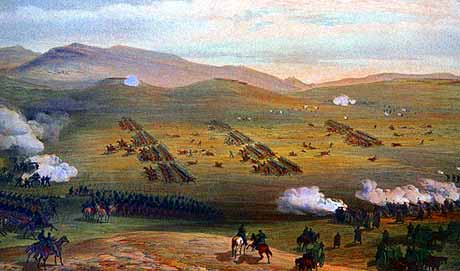
Charge of the Light Brigade
Crimean War

1845  Irish Potato Famine begin

1850. 3. 5.  Britain and France declared war on Russia. Crimean War begin


The Great Exhibition

Indian Mutiny 1857
1851. 5. 1.  The Great Exhibition opens at the Crystal Palace in Hyde Park, London

1857. 5. 10.  Mutiny in India

Charles Darwin and
The Origin of Species
1859. 11. 24.  Charles Darwin's "Origin of Species" is published

1861. 12. 14.  Prince Albert died at the age of 42

1868. 12. 9.  William Gladstone becomes prime minister 

The Suez Canal
1869. 11. 17.  Suez Canal opens, linking the Mediterranean and the Red Sea

1870. 8. 9.  Women obtain limited rights to retain their property after marriage

1876. 5. 1.  Victoria is declared empress of India

British Army in the Second Boer War
1899. 10. 10.  Second Boer War begins in South Africa


Reflection
  1. Which main topic does this artifact relate to? In what way?  This artifact is the timeline of the British Empire from 1800-1900.
  2. Why did you choose this artifact, and how much time did you spend on creating the artifact?  I spend about one and a half hour on this artifact. The events I choose are mostly major events in the British Empire during the 1800s.
  3. What understanding have you gained from the creation process of this artifact?  I have learned about some of the most influential events happen in the British Empire.
  4. Does this artifact reflect your best work and ideas? Why or why not?  Yes, the events in the timeline are all facts, so it is impossible to change it. However, I have try to put as many illustration as I could to make it look more interesting.
  5. Any additional comment? 
Rate this artifact from -5 to 5 in the following criterion:
  • Quality of your portfolio (4)
  • Level of enjoyment (4)
  • Learning (5)
  • Level of creativity and originality (4)

Gapminder Analysis

Gapminder Analysis
Graph No.1
Life Expectancy V.S. Income per Person
(1800-1900)
This is a graph of Life Expectancy vs Income per Person. What do notice about the graph? Please focus on Singapore. 


Here is a closer view of it
Notice that Singapore has greatly increase in both life expectancy and income after 1820. What cause this dramatic change? 
Sir Thomas Stamford Raffles
Before 1819, the Dutch has the control of most of the port around the Malay archipelago. However, in 1818, Sir Thomas Stamford Raffles, a Lieutanent Governor of the British colony of Bencoolen, has decided that the British should replace the Dutch as the new dominant force of the region. The reason why Raffles was so determined is that the Malay archipelago is lies between China and India. Therefore, it will be a great trading post for British and their opium trade with China. Raffles launched an expedition team and went to the Malay archipelago to look for a new naval base for the British. In 1819, Raffles arrived at Singapore and decided that this island will be a ideal place to set up a trading post. Raffles then met the local leader, and a formal treaty was sign on Febuary 6, 1819. Later on, under the British colonial ruled, Singapore has grown into a prosperous colony, as well as a important trading port.

Graph No.2
CO2 Emission (1820-1900)
The graph of CO2 emission from 18820-1900.
Lets focus on the United Kingdom(Scotland, Northern Ireland, England, etc) only
Check this out. Starting from 1820, the CO2 emission from the UK continue to rise. What cause the CO2 emission in the UK to increase?

The Industrial Revolution
During the 1800s, the British were going through the Industrial Revolution. The first thought about Industrial Revolution is factory. Many factories were been built during this time period. Most of the factories were using steam-power engine (Ex. Watts Engine) to power the machines. The principle for steam engine is that you burn coals and produce steam, and the energy from the steam makes the engine to work. The burning of coals release large amount of carbon dioxide (CO2). Therefore, when all the factories in the UK were burning coals, large amount of CO2 were release and the CO2 emissions start to rise.
Graph No.3
Fertility Rate V.S. Population
(1800-1900)
The graph of Fertility Rate vs Population
Please focus on Ireland
Look! Ireland's population has been growing since 1800, but what happen at 1849 that makes Ireland's population change in a blink of an eye?

In 1849, Ireland was still suffering from the Irish Potato Famine (1845-1852). Potato were the main food for most of the people in Ireland. When the potato famine start, many people died because of lack of food. According to research, the population of Ireland drop from 20%-25% because of famine. One million people died and another million emigrant from Ireland. The main cause of the Irish potato famine is because of a potato disease known as potato blight. The potato famine brought huge impact on human cost in Ireland.

Mother and Child digging potato.


Reflection
  1. Which main topic does this artifact relate to? In what way?  This artifact is about the use of Gapminder graph and the analysis(interpretation) on those graph.
  2. Why did you choose this artifact, and how much time did you spend on creating the artifact?  I spend about 2-3 hours on this (one-third of the time I spend on editing graphs). The indicators I choose on these graphs were the only indicator that shows data from 1800-1900.
  3. What understanding have you gained from the creation process of this artifact?  I understand some of the major events that happened in the 1800s, and the effect of these major events to the history.
  4. Does this artifact reflect your best work and ideas? Why or why not?  No, originally, I was trying to get the whole video that record the three graphs, but there are some errors when I try to put the video on the blog. Therefore, I choose photos instead.
  5. Any additional comment?  None
Rate this artifact from -5 to 5 in the following criterion:
  • Quality of your portfolio (4)
  • Level of enjoyment (4)
  • Learning (5)
  • Level of creativity and originality (3)

2010年10月28日 星期四

My Photo Story

Welcome to my photo story Prezi. In this Prezi, you will see the true Kaoshiung, as well as some traces left by the British.

We will focus on four main topic
  • Aspect of Realism
  • Aspect of Industrialization
  • Aspect of Imperialism
  • Aspect of Discovery
Please have fun with the slideshow.

Click on here to see the Prezi 
http://prezi.com/bqujyw7n0nac/my-photo-story/

Reflection
  1. Which main topic does this artifact relate to? In what way?  This is a photo slideshow that are related to aspects of imperialism, realism, and industrialization. It also include a short story of the photos. 
  2. Why did you choose this artifact, and how much time did you spend on creating the artifact?  I spend about 2 hours on this artifact. I choose these photos because I think photos is one of the best way to describe an idea.
  3. What understanding have you gained from the creation process of this artifact? Realism, British influence in Taiwan, Industrialization
  4. Does this artifact reflect your best work and ideas? Why or why not?  Yes, I spend all the field trip on finding photos best described the four aspects. I also choose the best photos for my Prezi slideshow, so I think this is my best work.
  5. Any additional comment?  I like taking photos, but my photography skills aren't so good.
Rate this artifact from -5 to 5 in the following criterion:
  • Quality of your portfolio (5)
  • Level of enjoyment (5)
  • Learning (5)
  • Level of creativity and originality (5)

2010年10月24日 星期日

Primary Source Evaluation (Voice from the Ranks)

Voice from the Ranks: preface

Sergeant Timothy Gowing, Royal Fusiliers

Taken from Timothy Gowing's Voice from the Ranks: a personal narrative of the Crimean Campaign (Nottingham: 1895). This document has been copied from its primary location on The Victorian Web.

Some may regard this work as of a very mixed character, nevertheless I am in hopes that it will both interest and entertain. And here I must beg my readers to remember that the book is submitted to their judgement as a record of facts, and not as an attempt at fine writing; I have confined myself strictly to a narrative of facts, whether the incidents related came under my own observation or otherwise.
I took part in some of the most desperate scenes in the Crimea - at the Alma I was one of those who led the way up the fatal Heights; at Inkerman I was in the thick of the fight and was wounded. I was beside that Christian hero Captain Hedley Vicars when he fell in his country's cause with the words on his lips, 'For England's home and glory, follow me!'.
I was also engaged in those memorable struggles that were carried on night after night, and day after day, before Sevastopol, and was wounded a second time in that bloody attack on Redan in which a Norfolk man - the late General (then Colonel) Windham - gained an immortal name. In giving my experiences during that campaign I may in some respects be repeating an 'oft-told-tale', yet, as a personal narrative, it will, I think, be new to many and will afford information not elsewhere to be found.
The letters to my parents from the seat of war in the Crimea I have ventured to publish, trusting they will prove of more than passing interest and set more than one thinking, 'Where is my boy tonight?' Many of them were written under great difficulty in a bleak tent or hut with the thermometer far below freezing point, with my wet rags frozen on my back; often my overcoat stiff with frost.
With confidence I now submit my work to my fellow-countrymen, trusting that none will criticise too harshly the humble literary efforts of one who has tried to do his duty upon many a hard-fought field, and who is ready to do it again rather than see that flag we love so well trampled in the dust.
T. Gowing
late Sergeant-Major, Royal Fusiliers

Origin
This preface was from the biography Voice from the Ranks: a personal narrative of the Crimean Campaign by Timothy Gowing, a sergeant from the Royal Fusiliers and a veteran of the Crimean War. Timothy Gowing published this biography as well as this preface in 1895.
The document above was published on the website Web of English History by Dr. Marjorie Bloy. The published date unknown.

Purpose
This document is a record of actual history happening of Timothy Gowing's experience during the Crimean War, as suggested in the preface. Timothy Gowing created this preface for his biography, Voice from the Ranks: a personal narrative of the Crimean Campaign, to inform the readers that this is a record of real events during the Crimean War, as well as some pre-warning about the book. This biography was published for the public in England to know the situation in the Crimean War, both the battle scenes and the daily life of a soldier. It also reveal some personel experience of Timothy Gowing during the war and his passion for his country.

Value
From this document, we know that Timothy Gowing was a member of the Royal Fusilier, and served in the Crimean War. We know he was a sergeant during the war and was promoted  to sergeant major later. We also know he was wounded more than once. According to this document, the time period was at the end of the 19th century. In the midle part of the 1800s, the Crimean War was taking place and the author was one of the witness as well as a participant in the war.Timothy Gowing was doing the narrator part in this document. The historical scenes in the book and in this preface were all from the perspective of Timothy Gowing, which he witnessed or experienced. This documen is purely a record of history and real events, and there is no controversies issues about the events in the book.

Limitation
In this document, the author did not addressed us clearly about all of his experience during the war. He only simply mentioned it. The reason he do so is because this document is the preface of his biography. A preface is use to address people about the intent of the book, but not the whole story. Therefore, this preface only told peopel what the biography is about. More detail will be address to the readers later when they are reading this biography.

Reflection
  1. Which main topic does this artifact relate to? In what way?  This artifact is about practicing primary source evaluation skill.
  2. Why did you choose this artifact, and how much time did you spend on creating the artifact?  I choose this preface as my artifact is because I am interested in war novel. I spend about one hour on this artifact.
  3. What understanding have you gained from the creation process of this artifact?  I have more practice on my primary source evaluation.
  4. Does this artifact reflect your best work and ideas? Why or why not?  Yes, I have tried primary source evaluation once, so I have some experience in doing this.
  5. Any additional comment?  I really don't like primary source evaluation.
Rate this artifact from -5 to 5 in the following criterion:
  • Quality of your portfolio (4)
  • Level of enjoyment (3)
  • Learning (4)
  • Level of creativity and originality (4)

2010年10月22日 星期五

The Crimean War

The Crimean War (1853-1856)

The Siege of Sevastopool

Brief Introduction
The Charge of the Ligth Brigade
The Crimean War is a war fought between Russia and France, British Empire, Ottoman Empire, and the Kingdom of Sardinia from 1853 to 1856. The Crimean War takes place mostly at the Crimean Penisula, Bulkan Penisula, Black Sea and others happened in Turkey which is the territory of the Ottoman Empire at that time. Russia lost at the end of the war, and the Treaty of Paris(28 February-30 March 1856) was made after the war. The Crimean War is said to be the first "modern warfare". Many new technology were first use in the war, as well as the weapons. The tectic also has great changes during the Crimean War.

Map of the Crimean War (Russian)
Countries Involved
  • France (Le Second Empire Francais)
  • Great Britain (British Empire)
  • Ottoman Empire (Devlet-i Aliyye-yi Osmâniyye)
  • Kingdom of Sardinia (Regno di Sardegna)
  • Russian Empire (Россійская Имперія)
Valley of the Shadow of Death
by Roger Fenton


Units Involved
  • France: 400,000
  • Great Britain: 250,000
  • Kingdom of Sardinia: 10,000
  • Russia: 1,200,000
  • Bulgaria volunteer: 7,000
The Causes of the War
Religion
One of the main cause of the Crimean War is religion conflict between the Eastern Orthodox Church in Russia and the Roman Catholic Church in France, as well as the Protestants in England. At first, Russia proposed to the Ottoman Empire to set up protaction area for the Eastern Orthodox Church in Turkey. However, the proposel was rejected by the Ottoman Empire. France and England also opposed the demand of the Russian Empire. As the result, the Russian Empire launched the invasion of the Ottoman Empire and the war eventually became the Crimean War.
The Thin Red Line, 93rd Highlanders

Expansion and Power 
Another main causes of the Crimean War is the desire of power and expantion. At the time before the war broke out, the Ottoman Empire was already falling apart. The Russian Empire think of this as a good chance of expanding its territory as well as gaining more power, especially area like Bulkan Pennisula and the Meditteranian Sea (for these area were important to militery usage). France and Great Britain, however, strongly opposed the expansion of the Russian Empire. The Bulkan Pennisula and the Meditteranian Sea were important passage way for France and Britain to their colonies in Asia. Therefore, in order to protect their power and goods, the British Empire and France declared war to the Russian Empire.

The Consequences of the War
Russia
After the Crimean War, the Russian Empire suffered terrible loses. The Russian Empire start to fall apart after the Crimean War and can no longer join the competition between countries in Europe. The Russian Czar also witness theurge of improvement in technology.

Britsih Empire and France
Russian soldiers in the Battle of Zouaves
Both suffered terrible loses, but both were able to preserve their power in the Meditteranian Sea and Asia. Also, the Britsh Empire and France have demonstratd the important of technology and the need of industrial revolution in order to gain power.

Kingdom of Sardinia
The Kingdom of Sardinia start to gain power after the war, and eventually rule over Italy and built a mighty kingdom.
Armstrong Canon,
 Ei Xi Bunker, Tainan County,
 Taiwan

Roger Fenton, a famous war
photographer during the
Crimean War
Important Influences of the War
  • Telegram was first used in the war
  • Explosive shells was fisrt used in the war
  • Steam-power metal-made battleship was first used in war
  • Railroad was first used in transporting supplies in war
  • Industrial Revolution and the improvement of weaponry
  • The improvement of field hospital
  • Media and reporter first appearence in war
  • First appearence of trench war
  • French Battleship Le Napoleon, One of
    the first steam-power battleship during
    the Crimean War
  • Calvary was officially retired from the first line fighting
Florence Nightingale
French soldiers advancing toward the
Russian line


Reflection
  1. Which main topic does this artifact relate to? In what way?  This artifact is about the Crimean War from 1853-1856.
  2. Why did you choose this artifact, and how much time did you spend on creating the artifact?  I choose the Crimean War is because I am interesting in researching about war, and the Crimean War is the first modern war with many new technology. I spend about 3-4 hours on this artifact.
  3. What understanding have you gained from the creation process of this artifact?  I have learned about the Crimean War. I also learned that one of the key ways to win a war is "New Technology"
  4. Does this artifact reflect your best work and ideas? Why or why not?  Yes, I spend two days on this artifact, so I think I have done my best in creating this.
  5. Any additional comment?  This is my best artfact, in my opinion.
Rate this artifact from -5 to 5 in the following criterion:
  • Quality of your portfolio (5)
  • Level of enjoyment (5)
  • Learning (5)
  • Level of creativity and originality (5)