2011年6月1日 星期三

Reflection

Reflection
Positive Comments
Most of my classmates were well prepared for their presentations, and most of them have some great themes and ideas. I learned a lot from their performance. They provided me with some great information about problems most of the people didn't know, yet are as important as any major problem in the world. My classmates have successfully inspired me to think about these problems and how they might have affect my life, as well as others. I really enjoyed most of their presentations.

Negative Comments
Although most of them are well-prepared, yet some people still have some problems of proper manners when giving presentations. For example, low volume, few eye contact, or stammering. Yet I don't blame them because some people just couldn't held back their nervousness. Also, time limit is also a problem. Some of us still need some good management of their time.

2011年5月24日 星期二

Problems & Solutions

Problems of Historical Relics

Destruction of Historical Relics
During the 5000 years of human history, human beings of different time have left a significant amount of histroical relics and ruins. Scholars study these ruins to complete the puzzle of human's history. However, most of the historical relics have suffered severe damages from both natural and human causes. The damages stop the historians dead in the track for further research. It is unfortunate to see the secret of our past and of our ancestor's life being bombed in war, or slowly eroding by the wash of rain.

One major cause for the destruction of historical relics are human. Human influence has been a major problem in many of the destruction of historical sites, both by society and individual. Society influence is one of the motive for humans to destroy these precious relics. For example, Mossulini and his Facist government has done some severe damages on the Colosseum of Rome during the World War 2. Damages done by the individual human beings is also a cause for the destruction of relics. For example, during the 18th century, farmers living in the countryside of England often takes the stones from the Hadrian Walls and various Roman fort in the surrounding to build or fix their own house.

Another major cause of destruction is the nature, the natural proccess of weathering has cause many historical relics to disappear or become unrecognizable and lost it's value. Plants growing on the ruins also cause some damages. Also, natural disasters, such as earthquake, can cause some serious damages and further destroy the relics. The washing of rain and the blowing of wind will slowly weather away the buildings and ruins and there is no stoping of the proccess.

Possible Solutions of Preservation
Despite all these damages already done by humans, people are starting to realize the importance of these historical relics and some have already taken actions in preserving these relics. For example, British lawyer, John Clatyon, has took actions in preserving the Hadrian Walls by purchasing lands surrounding the walls in order to prevent farmer from taking the stones during the 1830s.

Here is something you can try if you wish to preserve some historical relics that you feel important:
  • Contact local authorities or the UNESCO for them to survey the site and declare a preservation area for the site.
  • Get some friends with you, and patrol around the site for signs of people damaging the site.
  • Purchase the land like what John Clayton has done
  • Utilize various media and spread the message of preserving historical sites.
  • Persuade your friend into preserving historical sites, show them the importance of these relics.

2011年5月20日 星期五

Roman Influence

How do the Romans Influence Your World?
     The Roman Empire used to be one of the greatest empire in the ancient world, as well as in Western history. The Romans have achieve many things that others can't. The range of the empire stretch from Europe all the way to Asia and Africa. The Roman Empire was so prosperous and influencial. Even years after it's destruction, the influences of the Empire can still be seen in many part of the world until today.
    
      One of the main influence of the Roman Empire is religion. The Roman used to worship ancient Greek gods and goddess with Roman names. However, the idea of Christianity is also growing. The Romans used to oppress Christians under the command of the Emperor. When the Roman emperor Constantine I adopted Christianity and expand rights to worship Christianity, it became one of the most wide spread religion in the world. This spreading of Christianity later proved to be a great influence that can change the world's history. Now, Christianity is the most wide-spread religion in the world. Most US citizens nowaday are Christian, as well as in most European countries.
      
      Roman architecture is also a great influence on modern day buildings. Elements of modern city planning can be traced to Roman concepts. The Romans engaged in extensive city-building activities as they consolidated their empire. Roman military and colonial towns were laid out in a variation of highly planned grid. Developments in the architecture of fortification, relating to compact space and fast maneuverability, and the discovery of perspective, focusing the description on the eye of the viewer, led to radial focus in city plans and the development of ideal town plans. Many European cities, like London and Paris , sprang from these Roman origins. In Washington DC , building designs were derived from Roman styles. Roman theaters have also had some influences on the development of theaters in modern society.

      Another great influence by the Romans are the spreading of Latin language. Latin language is consider to be the basis of most Western languages, including English, Spanish, Italian, and French. Various Latin roots form the foundation of many English words. 

     One important area of influence was Roman law. The first law code in Roman history was the Law of the Twelve Tables, the precursor to the development of Roman law. Roman law developed the division between public law, in which the state is directly involved, such as with issues of treason and taxation, and private law, concerned with disputes between people, such as over contracts. This system was the basis for Civil law. Roman law also influenced the development of private international law. Romans had indictments and jury trials that is similar to today's practices. Many defense techniques can also be traced back to Roman procedures. The idea of “innocent until proven guilty,” also came from ancient Roman ideas. Also, the purpose of written law as a way to protect individuals from one another and from the power of the state is an Roman idea.
 
     The Romans also has various influences in our daily lives. For example, many kitchen tools you use in your kithcen such as knives and spoons are, in fact, used by the Romans back in their time. Also, the idea of highways is another great idea adopted by the Romans.
 
      In conclusion, the Roman Empire lasted for a very long time. It's various achievments is something that can't not be ignore. The Roman Empire has built the basis of the Western world, and it's influences has help form the world today in different areas.

2011年3月13日 星期日

The Zulu War

Anglo-Zulu War


The Zulu People and Zululand
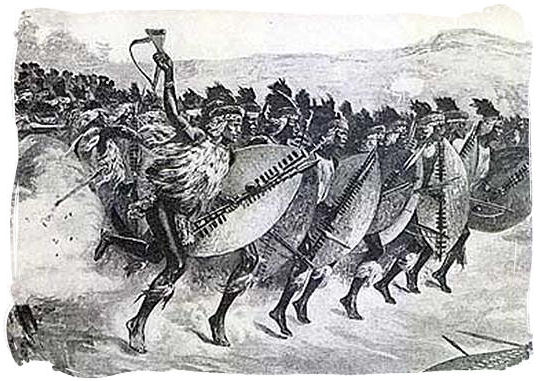
Zulu warrior
The Zulu are the largest South African ethnic group, with an estimated 10–11 million people living mainly in the province of KwaZulu-Natal. Small numbers also live in Zimbabwe, Zambia, and Mozambique. Their language, Zulu, is a Bantu language; more specifically, part of the Nguni subgroup. The Zulu Kingdom played a major role in South African history during the 19th and 20th centuries. Under apartheid, Zulu people were classed as third-class citizens and suffered from state-sanctioned discrimination. They remain today the most numerous ethnic group in South Africa, and now have equal rights along with all other citizens.

The Zulu Kingdom, sometimes referred to as the Zulu Empire or, rather imprecisely, Zululand, was a monarchy in Southern Africa that extended along the coast of the Indian Ocean from the Tugela River in the south to Pongola River in the north.
The small kingdom grew to dominate much of Southern Africa, but when it came into conflict with the British Empire in the 1870s during the Anglo-Zulu War, it was defeated despite early Zulu victories in the war. The area was subsequently absorbed into the Colony of Natal and later became part of the Union of South Africa.                                                                                                                           (From Wikipedia)
Historical Background
Cetshwayo, the king of Zulu
In 1862, Umtonga, a brother of Cetshwayo, son of Zulu king Mpande, fled to the Utrecht district, and Cetshwayo assembled an army on that frontier. According to evidence later brought forward by the Boers, Cetshwayo offered the farmers a strip of land along the border if they would surrender his brother. The Boers complied on the condition that Umtonga's life was spared, and in 1861 Mpande signed a deed transferring this land to the Boers. The south boundary of the land added to Utrecht ran from Rorke's Drift on the Buff to a point on the Pongola River.

The boundary was beaconed in 1864, but when in 1865 Umtonga fled from Zululand to Natal, Cetshwayo, seeing that he had lost his part of the bargain (for he feared that Umtonga might be used to supplant him, as Mpande had been used to supplant Dingane), caused the beacon to be removed, and also claimed the land ceded by the Swazis to Lydenburg. The Zulus asserted that the Swazis were their vassals and therefore had no right to part with this territory. During the year a Boer commando under Paul Kruger and an army under Cetshwayo were posted to defend the newly acquired Utrecht border. The Zulu forces took back their land north of the Pongola. Questions were also raised as to the validity of the documents signed by the Zulus concerning the Utrecht strip; in 1869 the services of the lieutenant-governor of Natal were accepted by both parties as arbitrator, but the attempt then made to settle disagreements proved unsuccessful.
Bartle Frere was relegated to a minor post in Cape Town.
A Resident was appointed to be the channel of communication between the chiefs and the British government. This arrangement led to much bloodshed and disturbance, and in 1882 the British government determined to restore Cetshwayo to power. In the meantime, however, blood feuds had been engendered between the chiefs Usibepu (Zibebu) and Hamu on the one side and the tribes who supported the ex-king and his family on the other. Cetshwayo's party (who now became known as the Usuthu) suffered severely at the hands of the two chiefs, who were aided by a band of white freebooters.
When Cetshwayo was restored Usibepu was left in possession of his territory, while Dunn's land and that of the Basuto chief (the country between the Tugela River and the Umhlatuzi, i.e. adjoining Natal) was constituted a reserve, in which locations were to be provided for Zulu unwilling to serve the restored king. This new arrangement proved as futile as had Wolseley's. Usibepu, having created a formidable force of well-armed and trained warriors, and being left in independence on the borders of Cetshwayo's territory, viewed with displeasure the re-installation of his former king, and Cetshwayo was desirous of humbling his relative. A collision very soon took place; Usibepu's forces were victorious, and on the 22 July 1883, led by a troop of mounted Boer mercenary troops, he made a sudden descent upon Cetshwayo's kraal at Ulundi, which he destroyed, massacring such of the inmates of both sexes as could not save themselves by flight. The king escaped, though wounded, into Nkandla forest. After appeals to Melmoth Osborn he moved to Eshowe, where he died soon after
(From Wikipedia)


Such was the political background when Cetshwayo became absolute ruler of the Zulus upon his father's death in 1873. As ruler, Cetshwayo set about reviving the military methods of his uncle Shaka as far as possible, and even succeeded in equipping his regiments with firearms. It is believed that he caused the Xhosa people in the Transkei to revolt, and he aided Sikukuni in his struggle with the Transvaal. The activities of the missionaries were unwelcome to Cetshwayo. Though he did not harm the missionaries themselves, several converts were killed. The missionaries, for their part, were a source of hostile reports. For example, Bishop Schreuder (of the Norwegian Missionary Society) described Cetshwayo as "an able man, but for cold, selfish pride, cruelty and untruthfulness, worse than any of his predecessors."


Battle of Rocke's Drift

In 1874 Lord Carnarvon, who had successfully brought about federation in Canada, thought that a similar scheme might work in South Africa. Sir Bartle Frere was sent to South Africa as high commissioner to bring it about. One of the obstacles to such a scheme was the presence of the independent states of the South African Republic and the Kingdom of Zululand.

In September 1876 the massacre of a large number of girls (who had married men of their own age instead of men from an older regiment, as ordered by Cetshwayo) provoked a strong protest from the government of Natal, and the occupying governments were usually inclined to look patronisingly upon the affairs of the subjugated African nations. The tension between Cetshwayo and the Transvaal over border disputes continued. Sir Theophilus Shepstone, whom Cetshwayo regarded as his friend, had supported him in the border dispute, but in 1877 he led a small force into the Transvaal and persuaded the Boers to give up their independence. Shepstone became administrator of the Transvaal, and in that role saw the border dispute from the other side.                                                                                                   (From Wikipedia)
British Involvement

Battle of Isandlwana

The pretext for the war had its origins in border disputes between the Zulu leader, Cetshwayo, and the Boers in the Transvaal region. Following a commission enquiry on the border dispute which reported in favour of the Zulu nation in July 1878, Sir Henry Bartle Frere, who found the award "one-sided and unfair to the Boers," delivered an ultimatum to Cetshwayo. Cetshwayo had not responded by the end of the year, so a concession was granted by the British until 11 January 1879, after which a state of war was deemed to exist.

Cetshwayo returned no answer, and in January 1879 a British force under Lieutenant General Frederick Augustus Thesiger, 2nd Baron Chelmsford invaded Zululand, without authorisation by the British Government. Lord Chelmsford had under him a force of 5,000 British and 8,200 Africans; 3,000 of the latter were employed in guarding the frontier of Natal; another force of 1,400 British and 400 Africans were stationed in the Utrecht district. Three columns were to invade Zululand, from the Lower Tugela, Rorke's Drift, and Utrecht respectively, their objective being Ulundi, the royal capital.

Battle of Intombe
Cetshwayo's army numbered fully 40,000 men. The entry of all three columns was unopposed. On 22 January the centre column (1,600 British, 2,500 Africans), which had advanced from Rorke's Drift, was encamped near Isandlwana; on the morning of that day Lord Chelmsford split his forces and moved out to support a reconnoitring party. After he had left the camp in charge of Colonel Anthony Durnford, was surprised by a Zulu army nearly 20,000 strong. Chelmsford's refusal to set up the British camp defensively and ignoring information that the Zulus were close at hand were decisions that all were later to regret. The ensuing Battle of Isandlwana was the greatest victory that the Zulu kingdom would enjoy during the war. In its aftermath, a party of some 4,000 Zulu reserves mounted a raid on the nearby British army border post of Rorke's Drift and were driven off after 10 hours of ferocious fighting.

While the British central column under Chelmsford's command was thus engaged, the right flank column on the coast, under Colonel Charles Pearson, crossed the Tugela River, skirmished with a Zulu impi that was attempting to set up an ambush at the Inyezane River, and advanced as far as the deserted missionary station of Eshowe, which he set about fortifiying. On learning of the disaster at Isandlwana, Pearson made plans to withdraw back beyond the Tugeala River. However, before he had decided whether of not to put these plans into effect, the Zulu army managed to cut off his supply lines, and the Siege of Eshowe had begun.
Meanwhile the left flank column at Utrecht, under Colonel Evelyn Wood, had originally been charged with occupying the Zulu tribes of north-west Zululand and preventing them from interfering with the British central column's advance on Ulundi. To this end Wood set up camp at Tinta's Kraal, just 10 miles south of Hlobane Mountain, where a force of 4,000 Zulus had been spotted. He planned to attack them on the 24 January, but on learning of the disaster at Isandlwana, he decided to withdraw back to the Kraal. Thus one month after the British invasion, only their left flank column remained militarily effective, and was too weak to conduct a campaign alone.

It had never been Cetshwayo's intention to invade Natal, but to simply fight within the boundaries of the Zulu kingdom. Chelmsford used the next two months to regroup and build a fresh invading force with the initial intention of relieving Pearson at Eshowe. The British government rushed seven regiments of re-inforcements to Natal, along with two artillery batteries.

During this time (12 March) an escort of stores marching to Luneberg, was killed at the Battle of Intombe, and all the stores were lost. The first troops arrived at Durban on 7 March. On the 29th a column, under Lord Chelmsford, consisting of 3,400 British and 2,300 African soldiers, marched to the relief of Eshowe, entrenched camps being formed each night.
Battle of Kambula
Chelmsford told Sir Evelyn Wood's troops (Staffordshire Volunteers and Boers, 675 men in total) to attack the Zulu stronghold in Hlobane. Lieutenant Colonel Redvers Buller, led the attack on Hlobane on 28 March. However, the Zulu main army of 26,000 men arrived to help their besieged tribesmen and the British soldiers were scattered. Besides the loss of the African contingent (those not killed deserted) there were 100 casualties among the 400 British engaged.

The next day 25,000 Zulu warriors attacked Wood's camp (2,068 men) in Kambula, apparently without Cetshwayo's permission. The British held them off in the Battle of Kambula and after five hours of heavy attacks the Zulus withdrew. British losses amounted to 29, while the Zulus lost approximately 2,000. While Woods was thus engaged, Chelmsford's column was marching on Eshowe. On 2 April this force was attacked en route at Gingindlovu, the Zulu being repulsed. Their losses were heavy, estimated at 1,200 while the British only suffered two dead and 52 wounded. The next day they relieved Pearson's men. They evacuated Eshowe on 5 April, after which the Zulu forces burned it down. 
(From Wikipedia)

Battle of Ulundi
The Battle of Ulundi took place at the Zulu capital of Ulundi on 4 July 1879 and was the last major battle of the Anglo-Zulu War. The British army finally broke the military power of the Zulu nation by defeating the main Zulu army and immediately afterwards capturing and razing the capital of Zululand, the royal kraal of Ulundi.                                                                                                                        (From Wikipedia)


Battle of Ulundi

Afterward
After this battle the Zulu army dispersed, most of the leading chiefs tendered their submission, and Cetshwayo became a fugitive. On 28 August the king was captured and sent to Cape Town (It is said that scouts spotted the water-carriers of the king, distinctive because the water was carried above, not upon, their heads). His deposition was formally announced to the Zulu, and Wolseley drew up a new scheme for the government of the country. The dynasty of Shaka was deposed, and the Zulu country portioned among eleven Zulu chiefs, including Usibepu, John Dunn, a white adventurer, and Hlubi, a Basuto chief who had done good service in the war.

2011年3月11日 星期五

Livingston & Stanley

 David Livingston
and
Henry Stanley

David Livingston (1813-1873)

David Livingstone was a Scottish Congregationalist pioneer medical missionary with the London Missionary Society and explorer in Africa.
Perhaps one of the most popular national heroes of the late 19th century in Victorian Britain, Livingstone had a mythic status, which operated on a number of interconnected levels: that of Protestant missionary martyr, that of working-class "rags to riches" inspirational story, that of scientific investigator and explorer, that of imperial reformer, anti-slavery crusader, and advocate of commercial empire.
His fame as an explorer helped drive forward the obsession with discovering the sources of the River Nile that formed the culmination of the classic period of European geographical discovery and colonial penetration of the African continent. At the same time his missionary travels, "disappearance" and death in Africa, and subsequent glorification as posthumous national hero in 1874 led to the founding of several major central African Christian missionary initiatives carried forward in the era of the European "Scramble for Africa".
(from Wikipedia)

Henry Morton Stanley (1841-1904)
Sir Henry Morton Stanley was a Welsh journalist and explorer famous for his exploration of Africa and his search for David Livingstone. Stanley is often remembered for the words uttered to Livingstone upon finding him: "Dr. Livingstone, I presume?", although there is some question as to authenticity of this now famous greeting. His legacy of death and destruction in the Congo region is considered an inspiration for Joseph Conrad's Heart of Darkness, detailing atrocities inflicted upon the natives.
(from Wikipedia)

The map of Livingston and Stanley's Journey


The Scramble for Africa (1885-1914)

Scramble for Africa (1885-1914)
The Scramble for Africa, also known as the Race for Africa was a process of invasion, attack, occupation, and annexation of African territory by European powers during the New Imperialism period, between 1881 and World War I in 1914.
As a result of the heightened tension between European states in the last quarter of the 19th century, the partitioning of Africa may be seen as a way for the Europeans to eliminate the threat of a Europe-wide war over Africa.
The last 59 years of the nineteenth century saw transition from ‘informal imperialism’ of control through military influence and economic dominance to that of direct rule. Attempts to mediate imperial competition, such as the Berlin Conference (1884–1885), failed to establish definitively the competing powers' claims.
Many African polities, states and rulers (such as the Ashanti, the Abyssinians, the Moroccans and the Dervishes) sought to resist this wave of European aggression. However, the industrial revolution had provided the European armies with advanced weapons such as machine guns, which African armies found difficult to resist. Also, unlike their European counterparts, African rulers, states and people did not at first form a continental united front although within a few years, a Pan-African movement did emerge.
(from Wikipedia)

Map of the Scramble for Africa


A comic illustration of the Scramble from historydudes.com

2011年3月1日 星期二

Economic and Time

Economic in Time
You might have heard the term “economic” many times, but what exactly does economic mean? Also, how does economic affect our daily life and the world? Economic is the study of how people satisfy their wants and needs with the limited resources they have. Economic often involve in money and currency. The two main bases of economic are wants and needs. Needs are our basic needs to survive, and wants are everything else beside needs and are unlimited. People have wants and needs, and when they take actions to satisfy their wants and needs it involve economic. Economic is in every corner of the world. You involve in economic every day. Economic has exists for a very long time in human history. As the time proceeds and technology advance, economic has evolved into various form and has more connection with the world rather than individual.

        In the ancient time of the human being, people used to be self-reliant, meaning that they are able to fulfill their own wants and needs using any resources they can get from their environment. People grow their food and make their own cloth. Later in time, when people start to come and live together, towns and villages were formed. People then start to trade with each other using what they have for what they need. During the Middle Ages, most of the people’s possession belongs to the rulers or the upper class and little for the people themselves.

        It is not until the 19th century that people start to come up with ideas that made up most of the modern day economy. 19th century is the time of changes and revolutions. It is the time where capitalism and socialism rise to power. “Capitalism” is a kind of economic system which the means of production and profits were privately own. It is the idea of a 19th century British philosopher named Adam Smith. Good thing about capitalism is that it generate large amount of profit and boost up the economy. However, it often results in the exploitation of the working class for most of the profit goes to the middle class and the upper class. The working class only got a very few share. This is when “socialism” rise to power and compete against capitalism. Socialism is a kind of economic system in which the means of production and profits were public own. In socialism, people cooperate and share the profit. It Is the idea of a 19th century German philosopher named Karl Marx. Socialism can produce a fair and cooperative economy. However, not everyone wants an equal share and socialism often results in the exploitation of the middle class. Also, it is hard to boost up the economy when all the profit was equally divided.

        So what should people do if they want a fair economic system that also generate large amount of profit? The solution is a “mixed economy”. A mixed economy is the combination of the idea of both capitalism and socialism. The mixed economy allows means of production and profits to be privately own. However, the employer or the middle class must give the working class the share and treatment they deserve. The idea of mixed economy also started out in the 19th century, and is most common economic system adopted by the developed nations. Usually, in a mixed economy, there are two main factions, the enterprise and the labor union. The enterprise is the middle class people who generate and own the profit. The labor union is mostly consisted of people from the working class. These people help the enterprise generate profit, but don’t own the profit. They could, however, demand the enterprise to give them a proper share of profit or treatments. If not, they could go on a strike which will cause the generation of the profit to stop. Mixed economy balances the power between the working class and the middle class.

        The reason people study economics is because they want to have a good idea on whether they are spending their limited resource in a good way. People want to know if they make full-use of the resources. They want to know if they are making the right decision, in another word, does it worth it? Economic have change in time. It has evolve from the basic self-reliant economic to global economic which everyone in this world is responsible for the change in it. Economic has become one of the greatest global issues nowadays. It is now the representation of power in modern day.


2011年2月18日 星期五

Socialism & Capitalism


Socialism VS Capitalism
 Socialism
  • A kind of economic system
  • public ownership
  • self-management
  • equal power-relation
  • working class- the main supporter
  • exploitation of the middle classes
  • Nationalization of the means of production
  • Cooperative managment of the means of production
  • Allocation of resources
  • Free association
  • Direct production of use-value
  • Every person has the power of decision making
  • Late 18th century
Capitalism
  • A kind of economic system
  • privte ownership
  • private profit
  • private decision regarding supply, demand, price, distribution, and investments
  • Free market
  • laissez faire (no goverment intervention)
  • middle class- the main supporter
  • exploitation of the working class
  • most of the means of production are private own
  • no power of decision making for the working class
  • economic growth
  • right to control property
  • 16th century

the Manifesto

Communist Manifesto

The Communist Manifesto, originally titled Manifesto of the Communist Party (German: Manifest der Kommunistischen Partei) is a short 1848 book written by the German Marxist political theorists Karl Marx and Friedrich Engels. It has since been recognized as one of the world's most influential political manuscripts. Commissioned by the Communist League, it laid out the League's purposes and program. It presents an analytical approach to the class struggle (historical and present) and the problems of capitalism, rather than a prediction of communism's potential future forms.
The book contains Marx and Engels' Marxist theories about the nature of society and politics, that in their own words, "The history of all hitherto existing society is the history of class struggles." It also briefly features their ideas for how the capitalist society of the time would eventually be replaced by socialism, and then eventually communism.

From Wikipedia, the Free Encyclopedia

A Communist "Party"

A Communist "Party"
An original T-shirt graphic by Tom Burns

Starting from Right to Left:
  1. Karl Marx, German philospher, the author of the "Communist Manifesto", the forefather of Socialism/Communism.
  2.  Vladimir Lenin, Russian communist politician and revolutionary, the leader of the communist party in Russia who started the October Revolution.
  3. Mao Ze Dong, Chinese communist politician and revolutionary, the leader of the of the communist party in China, the founder of China People Republic.
  4. Fidel Castro, Cuban communist politician and revolutionary, the leader of the Cuban Revolution, the former prime minister and president of Cuba.
  5. Joseph Stalin, Russian communist politician and dictator, the leader of the Soviet Union from 1943-1953, the biggest killer of the 20th century beside Adolf Hitler.   
My political status is neutral. I do not support communism, nor any other political idea.
I just found this as an interesting idea of interpreting Communist party.

Bastille

La Prise de la Bastille

The storming of the Bastille prison on July 14th, 1784
The Apocalypse of the French Revolution. 


The Bastille
The Bastille was a fortress-prison in Paris, known formally as Bastille Saint-Antoine—Number 232, Rue Saint-Antoine—best known today because of the storming of the Bastille on 14 July 1789, which along with the Tennis Court Oath is considered the beginning of the French Revolution. The event was commemorated one year later by the Fête de la Fédération. The French national holiday, celebrated annually on 14 July is officially the Fête Nationale, and officially commemorates the Fête de la Fédération, but it is commonly known in English as Bastille Day. Bastille is a French word meaning "castle" or "stronghold", or "bastion"; used with a definite article (la Bastille in French, the Bastille in English), it refers to the prison.

The Storming of Bastille and the French Revolution
The confrontation that led to the people of Paris storming the Bastille on 14 July 1789, following several days of disturbances, resulted from the fact that gunpowder and arms had been stored there, and the people (whose fears had been raised by a number of rumors) demanded access to these. The later idea that they wanted to free the prisoners (only 7 of whom remained) has been discounted. The regular garrison consisted of 82 invalides (veteran soldiers no longer capable of service in the field) under Governor Bernard-René de Launay. They had however been reinforced by a detachment of 32 grenadiers from one of the Swiss mercenary regiments summoned to Paris by the King shortly before 14 July.

The Bastille prison, after storming
A crowd of around 8800 men and women gathered outside around mid-morning, calling for the surrender of the prison, the removal of the guns and the release of the arms and gunpowder. Two people chosen to represent those gathered were invited into the fortress and slow negotiations began.

In the early afternoon around 1:00, the crowd broke into the undefended outer courtyard and the chains on the drawbridge to the inner courtyard were cut. A spasmodic exchange of gunfire began; in mid-afternoon the crowd was reinforced by mutinous Gardes Françaises of the Royal Army, and two cannons, all of which were originally supposed to help the governor protect the prison. De Launay ordered a ceasefire; in spite of his surrender demands being refused, he capitulated and the vainqueurs swept in to take control of the fortress at around 5:30.

When the rioters entered the Bastille, they collected cartridges and gunpowder for their weapons and then freed the seven prisoners (which they had to do by breaking down the doors, since the keys had already been taken off and paraded through the streets). Later, the governor and some of the guards of the Bastille were murdered under chaotic circumstances, despite having surrendered under a flag of truce, and their heads paraded on pikes.

The Bastille Day
Military March on Bastille Day
Bastille Day is the French national holiday which is celebrated on 14 July each year. In France, it is formally called La Fête Nationale (The National Celebration) and commonly le quatorze juillet (the fourteenth of July). It commemorates the 1790 Fête de la Fédération, held on the first anniversary of the storming of the Bastille on 14 July 1789; the anniversary of the storming of the Bastille fortress-prison was seen as a symbol of the uprising of the modern nation, and of the reconciliation of all the French inside the constitutional monarchy which preceded the First Republic, during the French Revolution. Festivities are held on the morning of 14 July, on the Champs-Élysées avenue in Paris in front of the President of the Republic.

From Wikipedia, the Free Encyclopedia

2010年12月8日 星期三

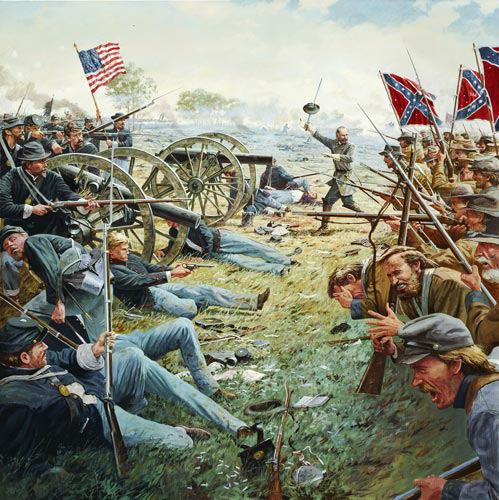
Idea Page (Civil War)

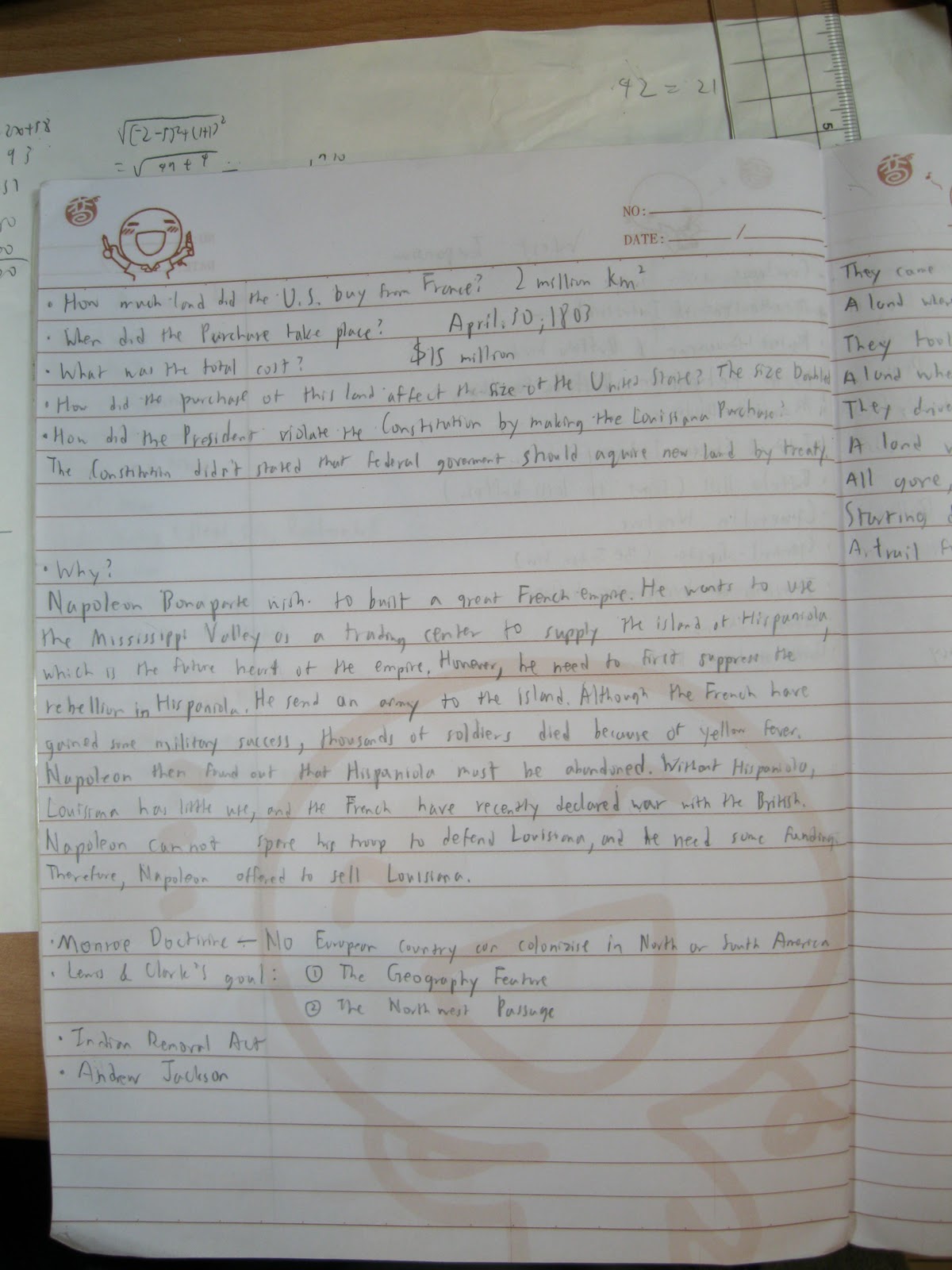
Idea Page (Louisiana Purchase and Indian Removal Act)

Book Talk

Soldier's Heart

Introduction
Book Cover
     Soldier's Heart is a historical novella written by Gary Paulsen. The novella tells the story of a 15 year old boy, named Charley Goddard, who lied about his age to join the First Minesota Volunteer, which is under Union control, to fight the Confederacy in south. The time period is set in 1861 which is the time when the American Civil War started. The story take the reader through the Charley's perspective about the reality of Civil War, including the brutality of war and the hardship of soldiers in combat. At the end of the book, the author tells about Charley's life after war, and the trauma left on Charley by the war.

Story
    The story start when 15-years-old Charley Goddard decided to join the Union army to fight the Confederacy. Charley, at that time, had no idea what a war look like and decided to fight in order to understand it. Charley later convince his mother, who also had no idea what a war look like, to let him join the army. Charley than lied about his age to the admission and get enlisted into the First Minesota Volunteer.
Battle of Bull Run
    Later, the story take the readers to the daily life of Charley in the army. In the letters Charley wrote to his mother, he claim that the army are boring and the food weren't very good. Charley also mention about the inexperience officers that was elected by the men. Charley than told his mother about the war. Charley and his men were all claiming that the war will be easy, and the south will surrender way before they see some action.
    While Charley was on the way to their new camping place, Charley's mother start to think about war and the consequence of war. She wrote to Charley about the consequences of war, but Chaley ingored. While on the way to their new location, Charley and his men were welcomed and cheered by peoples. They were treated as heros. When Charley and his regiment were changing train in order to keep going, Charley met a black slave who give him a piece of cake and thank Charley for what they are doing.
     Later on, Charley had his first taste of war in the Battle of Bull Run, which Charley found out suddenly the reality of war and the violence and death in it. The Union lost the battle, and Charley witnessed the death of thousands of soldiers and wish all would stop.
In Gettysburg
     After Bull Run, Charley and his regiment stay at a camp near Washington. There, Charley and his fellow soldiers steal food from farms and build log to prepare for winter. Some of Charley's fellow soldiers caught up with disease such as dysentery, and some of the men died. Charley later fought in another battle with Rebels near Washington. In that battle, Charley met Nelson, a new replacement of the Second Minesota Volunteer. Nelson was shot in the stomach during that battle and he know that the surgeon won't be able to fix him because stomach wound require a lot of time and skills, so Nelson shot himself.
     Charley later on  fought in an battle near Richmond. This time, a Confederate cavalry launched an attack on Charley and his man, but were soon shot to pieces under Union fire. After they defeated the cavalry, Charley and his men were soon attack by another regiment of infantry. The two side than engaged in a hand-to-hand battle which eventually routed the South.
     Charley, at the last part of the book, fought in tthe Battle of Gettysburg, which Charley was severly wounded but soon recover.
     After Civil War, Charley return home. The book then take the readers on one of Charley's picnic. Charley found a revovler which he took from a dead Confederate officer. Charley was studing it, while his memories of war come back into his mind. He then put the gun away and stop thinking about it.

True or False
First Minnesota Monument in
Gettysburg
The author, Gary Paulsen, stated that all of events in the book are true, including walls made of dead bodies in order to stop the wind. Charley Goddard is a real life character. Charley did lied about his age and join the First Minesota Volunteer. Charley did not fight in the Battle of Bull Run, but except for that Charley has fought every battles that was mention in the book. Charley, however, wasn't wounded in Gettysburg. He is also not one of the 47 men in the First Minesota Volunteer that survive after Gettysburg, for he had dysentery at was in the hospital. Charley later return home but died at the age of twenty-three because of his wartime trauma and wounds he recieved in war.

2010年12月5日 星期日

Movie Review

Spirit: Stallion of Cimarron
The Wild West through a Mustang's Eye

Intro
Spirit: Stallion of Cimarron
Spirit: Stallion of the Cimarron is a 2002 animated film that was released by DreamWorks. It follows the adventures of a young mustang stallion, named Spirit, living in the 19th century wild west. The film, written by John Fusco and directed by Lorna Cook and Kelly Asbury, was nominated for the Academy Award for Best Animated Feature. In contrast to the way animals are portrayed in an anthropomorphic style in other animated features, Spirit and his fellow horses communicate with each other through sounds and facial expressions. Spirit's thoughts are narrated by his voice actor Matt Damon.                 --from Wikipedia

Story

Inside the DVD

The film starts with a brief introduction featuring a bald eagle gliding over the homeland of the mustangs, which resembles several western US National Parks. There is then a scene showing the birth of a Buckskin Kiger Mustang, the main protagonist, Spirit. Spirit soon grows into a stallion, and assumes the role of leader of the herd, whose duty it is to keep the herd safe.


Young Spirit and his mother
Spirit is a courageous leader, but has a serious mischievous streak and a high sense of curiosity. Spotting a camp one night not far from his herd, the stallion is unable to control his curiosity and moves towards it, as he's never seen humans before. To Spirit's surprise, the humans (possibly wranglers) are vicious. After a long chase, he is captured and taken to a US cavalry post. During this time in the movie, the army is fighting the Indian Wars and taking over the soon-to-be western United States. There he encounters "The Colonel" (based on Colonel Custer). The Colonel attempts to tame the mustang, but Spirit manages to outwit all who attempt to ride him. During this time, a Lakota American Indian named Little Creek is also brought into the fort and held captive, through the night and day they become friends. Through a series of events, Little Creek and Spirit escape the post. Little Creek's own paint mare, Rain, meets them, along with other Indians who loosely capture Spirit.

After returning to the Lakota Indian village, Little Creek ties Spirit and Rain together, much to Spirit's dismay. Rain willingly shows Spirit her world. Spirit begins to understand their ways and falls in love with the mare. His affections for Rain, however, do not soften his yearning to be free.


Spirit and his girlfriend, Rain

At the end of their time together Little Creek decides that Spirit should never be tamed and frees him. As Spirit asks Rain to come with him to his herd, a Cavalry Regiment led by the Colonel attacks the Lakota village. Rain is shot by the Colonel, knocking her into the river while Spirit knocks the colonel off his horse, saving Little Creek's life. Spirit dives into the river to try to rescue Rain, but is unsuccessful and they both plummet over a waterfall. Having both survived, Spirit comforts Rain on the riverbed until cavalry scouts tear him away. After finding Rain critically injured just as Spirit is being led away, Little Creek vows to free the mustang once and for all in accordance with his life-debt; and follows the men after tending to his own mare.
Spirit and other stolen horses are put on a train and taken to the work site of the Transcontinental Railroad where they are put to work pulling a locomotive engine up a mountain when attempts to tunnel have failed. Spirit realizes that if the track extends along its present course it will infringe on his homeland. Spirit breaks free from the steam engine and causes it to fall down the steep hill where it collides with another locomotive, causing a boiler explosion which starts the camp and woods on fire. Little Creek appears and escapes the wildfire with Spirit.

Ending scene where Spirit and Rain
say goodbye to Little Creek, the Lakota Indian
The next morning, Colonel and his men find Spirit and Little Creek. A climatic chase scene ensues on winding rock passages that lead to a canyon where the two again outsmart the Army. Spirit also makes a "freedom" jump which amazes The Colonel. The Colonel stops one of his men from shooting the two and exchanges nods of respect with Spirit before they part.

Spirit races back to the rebuilt Lakota village with Little Creek. Spirit finds Rain still alive, nursed back to health by the Indians. Little Creek decides to name the Kiger mustang "Spirit-who-could-not-be-broken". Little Creek, knowing it's for the best, sets Spirit and Rain free. Eventually, the two horses joyfully meet up with Spirit's own herd. Viewers then see the eagle as he flies up into clouds shaped like horses.
--from Wikipedia

Production Staff
Poster
Directed byLorna Cook
Kelly Asbury
Produced byMax Howard
Jeffrey Katzenberg
Mireille Soria
Written byJohn Fusco
Narrated byMatt Damon
Starring
Matt Damon
James Cromwell
Daniel Studi
Music byHans Zimmer
Bryan Adams
Editing byClare De Chenu
StudioDreamWorks Animation
Stardust Pictures
Distributed byDreamWorks Pictures
From Wikipedia

My Feedback
The Smile
It had been a long time since the last movie that has impress me so much. In truth, I haven't seen such well-made animation for a very long time. The animations nowaday are mostly focus on comedy and humor, which, saddly, coruppted those annimations into a themeless and somewhat retarded piece of garbage. At this point, I have to say that the advancement of technology really corrupt human and make human lazy and regress. Indeed, 3D computer animation did impress people and make people marvel at the advancement of technology. However, the technology will be worthless if the film, which a lot of them do nowaday, is mostly goofing and has little theme.

Spirit, in other hand, is of a completely diferent story to me. Although it is traditionaly animated and some may think of it as old fashion, this type of animation brought us the cherish of the past when most of the animations are hand-drawn, especially when all of sudden that 3D computer animations are all over us. When watcing the film, the view throughout the camera, with the combination of the touching background music, is truly breath-taking. Also, Spirit contain varies important themes. It is a combination of love, home, freidship, wilderness, freedom, valor, and nature. It is really impressive in the way the director express these various themes through the film, and yet keeping the film pure and full of fantasies. 

Spirit and his friend, the Eagle
I've watched many animations, including some of the famous Disney animations like The Lion King, when I was still young (about 6-10). However, out of all these films, the one and only film I remebered the most is Spirit even though I only watch part of it for only one time. When I saw this film accidently ( I was browsing through the movie channel) 8 years later, this struck me as pure and full of fantasy, yet still contain many themes that inspire people. It is so pure and simple that seems to brought the audience back to a pure and innocent child that has nothing in his/her mind except for various imaginations and fantasies. I've to say that there isn't one negative comments I can think of toward this movie. This film brought back the feeling that I once posess as a child but was long lost, and I am very thankful for that.

Also, the music is one of the best soundtrack I've ever heard in various movies. The music is a very important element throughout the film. There weren't much dialog between characters. Therefore, background music became important in subsituting dialog. The music gives the feeling of the Wild West and the nature. The soundtrack seems to also contain the themes in the movie. In my opinion, it suit the film perfectly. Another thing that interest me is that the way the animal character communicate. Unlike other animal animation, they use sounds and expressions to communicate, and I think it is pretty new and true for animals.

In conclusion, Spirit is a really unique and impressive film. It has no sequel, which makes it the more special and mantain its quality. There have been over hundreds of animation, but the only one that impress me the most is this. Therefore, I wish truly that whoever read this review must watch the film, for the ones that watch it already watch it again.


P.S. Sorry if it is to long. I have a lot to say bout it.